The Window of Tolerance
At this time of the term, as we're coming in to land, you may be over it. Life, people, problems, all of it. It's so normal. The window can feel like it's shrunken to doll size. It's so normal. A reminder for us all, we're human, not perfect.

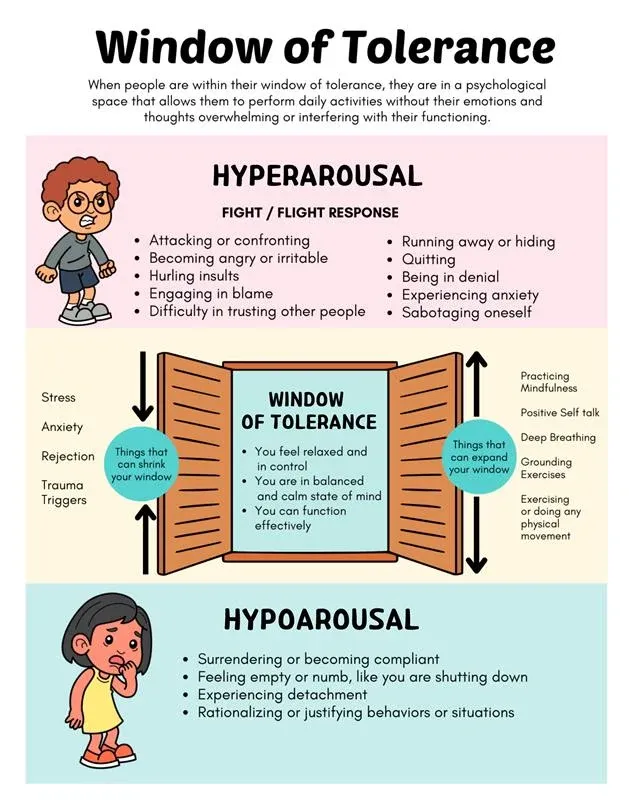
We have three zones of arousal within our autonomic nervous system.
Hyperarousal; the nervous system state of "go" to meet the challenge, or get away from the challenge, we encounter. They system mobilises energy in order to deal with the challenge. We commonly know this as the "flight/fight" response.

Hypoarousal; the nervous system state of "no" I can't meet the challenge encountered. The system withdraws energy, all energy goes inward as opposed to outward and the person may appear withdrawn and detached.

Regulated; that space where we perceive we are safe, this is also called the window of tolerance.

I talk a lot about regulation, but I do find the term window of tolerance useful as a visual representation of what's happening in our nervous systems.
Dr. Dan Siegel coined the term "window of tolerance" and described it in his book The Developing Mind originally published in 1999.
The thing I want to share about the window of tolerance is that we are not born with one size window that is set for life. Our window of tolerance contracts and expands for various reasons continuously.
There are days when you just know your capacity is limited. Ever warned your kids that your fuse is extremely short, and "don't even look at the fuse" ? Me too. This is a clue we're at the very edge of our window. We even use language like "I'm on the edge. Don't push me over!" Many/most/all (?) of us have an experience of how it feels to be on the psychological edge of what we have capacity to deal with.
The end of the term can be a good example of when we may be on the edge or even stepping outside of our window of tolerance more frequently and easily. Something we could tolerate at the start of the term is now pushing us over the edge. As the diagram shows, tiredness, stress, anxiety, relational difficulties and trauma can affect the size of our window of tolerance.
At this time of the term, as we're coming in to land, you may be over it. Life, people, problems, all of it. It's so normal. The window can feel like it's shrunken to doll size. It's so normal. A reminder for us all, we're human, not perfect.
When our window shrinks, we may go into a more hyperaroused state, perhaps more anxious, sensitive, defensive and overwhelmed. Or, we could go into more hypoarousal with increased withdrawing behaviour, numbing and loss of motivation. Or, we could ping-pong between the different states.
How do we widen our window?
Notice where you're at. Does it feel like you're more snappy, less patient, more withdrawn, or maybe in more chaos than usual? These all might be clues that your window has done an end-of-term shrink.
Take stock. I know I've given this advice so many times, but only because I do it for myself personally and it really helps. Take stock of what has happened this year, or even just this term. It can help to put into perspective what you've been dealing with and just how heavy the load has been. To acknowledge the difficulties, and/or celebrate the wins!
Insight to action. Use the insight you've gained through stock-taking and do something with it. Whether it be doing some exercise, journalling, breathing, expressing gratitude to yourself and others. Take an action from the insight, this helps to integrate what you're learning about yourself in the moment.
Get another perspective. I've had a situation this week where I have had an over-reaction to something I would normally be able to deal with in a more balanced way. But, because this term has taken a lot out of me emotionally and physically, and I am tired, my window is small. I went to a friend and asked for her perspective. It can be a "I really need to process this with you" phonecall, or a quick cup of coffee, or even a voice note. It's helpful to get the perspective of someone who you know won't add to your drama or chaos, but gently help you to take a breath either literally or figuratively.
States exist for a reason. It is important to know that when we go into a hyper or hypo aroused state, that our system does this in order to keep us safe. If it doesn't feel safe to be in connection with others, we withdraw. We can't withdraw from society forever and still be in healthy connection with ourselves and others, but we can withdraw for a time in order to regain energy through rest and reflection. If we're in "fight" mode, it can be helpful to use that state to exert physical energy in a healthy and meaningful way such as doing a HIIT workout, or going dancing.
In essence, use the state you're in to channel your energy into an activity that is meaningful for you and makes use of that energy as best you can in order to get to a place where you feel safe within yourself.
As we explore our window of tolerance, we get to pay attention to our bodies and what they are communicating to us.
Announcement!
Do you know what else affects our window of tolerance? Transitions! Come and join me at the Journalling through Transitions workshop on 3 October. A safe space to help you process any changes you've been through this year. We will use fun collaging activities to help prompt thinking and processing transitions.